


10 Potential Benefits Of Vaping Compared With Smoking
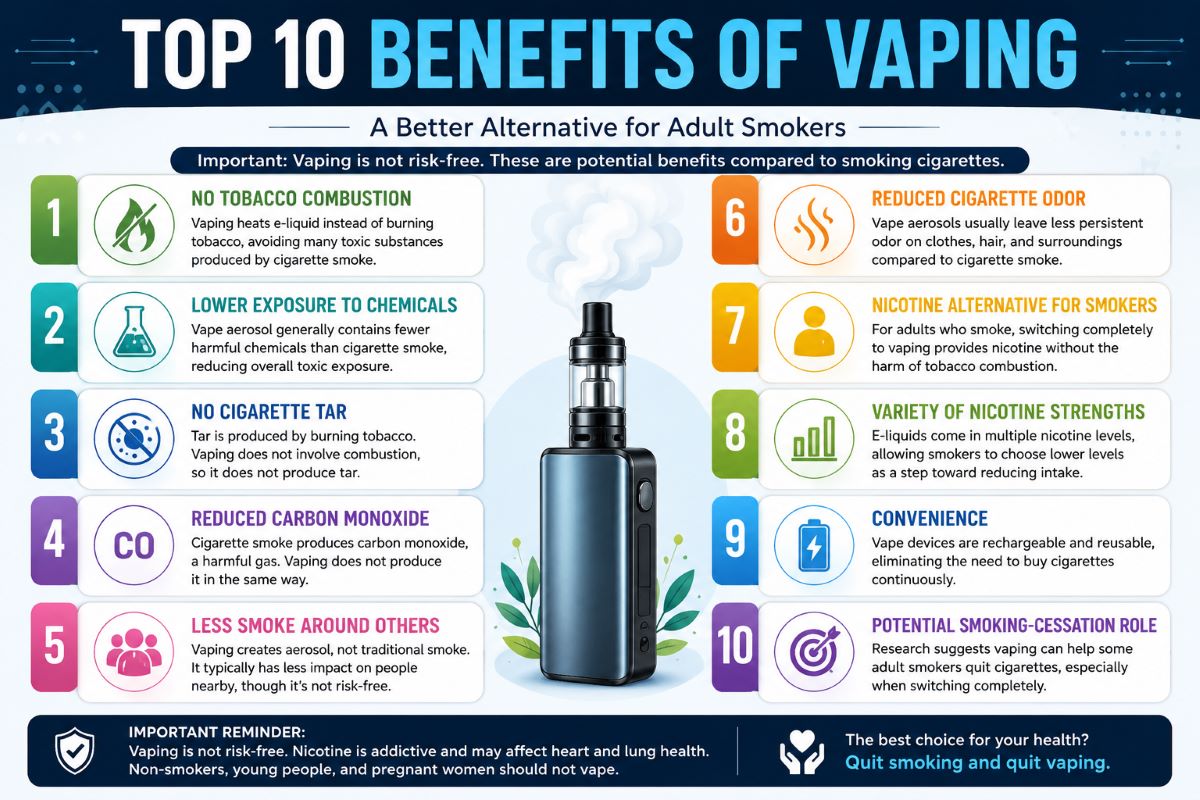
Vaping has become increasingly popular as an alternative to traditional cigarette smoking. Electronic cigarettes, commonly known as vapes or e-cigarettes, heat a liquid to produce an aerosol that users inhale rather than burning tobacco. While vaping is not risk-free, public discussion often focuses on its potential benefits for adult smokers who are looking for an alternative to conventional cigarettes. The key point is that any potential advantage should be understood as a comparison with smoking, not as evidence that vaping is healthy.
- No tobacco combustion
One of the main differences between vaping and conventional smoking is the absence of tobacco combustion. Cigarettes burn tobacco at high temperatures, producing smoke containing thousands of chemicals. Vaping devices heat an e-liquid instead. Avoiding combustion can reduce exposure to many of the toxic substances associated with cigarette smoke.
- Lower exposure to certain harmful chemicals
Compared with cigarette smoke, vape aerosol generally contains lower levels of many harmful chemicals. This is one reason vaping is sometimes considered a harm-reduction option for adult smokers who would otherwise continue smoking. However, vape aerosol can still contain potentially harmful substances, so lower exposure does not mean no exposure.
- No cigarette tar
Tar is produced when tobacco burns and is a major component of cigarette smoke. It contains numerous toxic compounds that can accumulate in the lungs. Because vaping does not involve burning tobacco, it does not produce cigarette tar in the same way.
- Reduced carbon monoxide exposure
Burning tobacco produces carbon monoxide, a poisonous gas that reduces the blood’s ability to carry oxygen. Vaping does not involve tobacco combustion and therefore generally results in substantially lower carbon monoxide exposure than smoking cigarettes. This can be an important distinction for smokers considering alternatives.
- Less persistent smell
Cigarette smoke has a strong and persistent odor that can remain on clothing, furniture, vehicles and indoor surfaces. Vape aerosols usually have less of the characteristic tobacco smell. Depending on the e-liquid, vaping may produce a scent that disappears more quickly, although this does not eliminate concerns about indoor aerosol exposure.
- Different nicotine options
Many vaping products are available with different nicotine concentrations. For adult smokers, this can provide flexibility in managing nicotine intake. Some smokers may gradually reduce the nicotine concentration over time as part of an attempt to move away from nicotine dependence.
- Potential smoking-cessation tool
One of the most discussed potential benefits of vaping is its role in helping adult smokers quit cigarettes. Some research suggests nicotine e-cigarettes can help smokers stop smoking, particularly when vaping completely replaces cigarettes. The greatest potential harm-reduction benefit comes from switching completely rather than continuing to smoke and vape indefinitely.
- No ash or cigarette butts
Traditional cigarettes produce ash and discarded cigarette butts, which contribute significantly to litter. Vaping eliminates cigarette ash and can reduce the volume of cigarette-butt waste. Nevertheless, disposable vape devices and e-liquid containers create their own environmental waste and require appropriate disposal.
- Greater convenience for some users
Rechargeable vaping devices can be used repeatedly without carrying a pack of individual cigarettes. Users can also choose from different device types, flavors and nicotine strengths. This flexibility is one reason vaping has attracted many adult smokers looking for alternatives.
- May support a transition away from smoking
For some smokers, vaping can serve as an intermediate step between conventional cigarettes and quitting nicotine altogether. A smoker may first replace cigarettes with vaping and subsequently work toward reducing nicotine consumption. The objective should be to move away from combustible tobacco rather than simply establish long-term dependence on another nicotine product.
The potential benefits of vaping are primarily relevant when comparing it with conventional cigarette smoking. Vaping is not harmless, and people who do not smoke should not start vaping simply because it may expose users to fewer toxic substances than cigarettes. Nicotine can be addictive, and vaping may have health effects that continue to be studied. For adult smokers, however, completely switching from cigarettes to vaping may reduce exposure to some of the harmful chemicals associated with tobacco combustion. For the greatest health benefit, ultimately quitting both smoking and vaping remains the preferred goal.
Contributed by GuestPosts.biz