


Making Your Content Ready For AI Agents, Not Just AI Answers
Picture this. Someone tells their AI assistant: “Find me organic cotton sheets, queen size, under 150 dollars, with at least a 4.5-star rating, and order them if you find a good match.” The assistant does not open ten browser tabs and read reviews the way a person would. It queries product data, compares structured information across sites, checks pricing and availability, and in some cases completes the purchase -all without a human ever looking at a single product page.
This is not a hypothetical future. Versions of this are already happening, and the trajectory is clear enough that some industry analysts are predicting a meaningful share of e-commerce transactions will be machine-initiated within the next several years. Gartner, in widely-cited research, projected that traditional search engine volume could decline significantly as more people shift toward AI assistants and agents to get things done rather than to find information and act on it themselves.
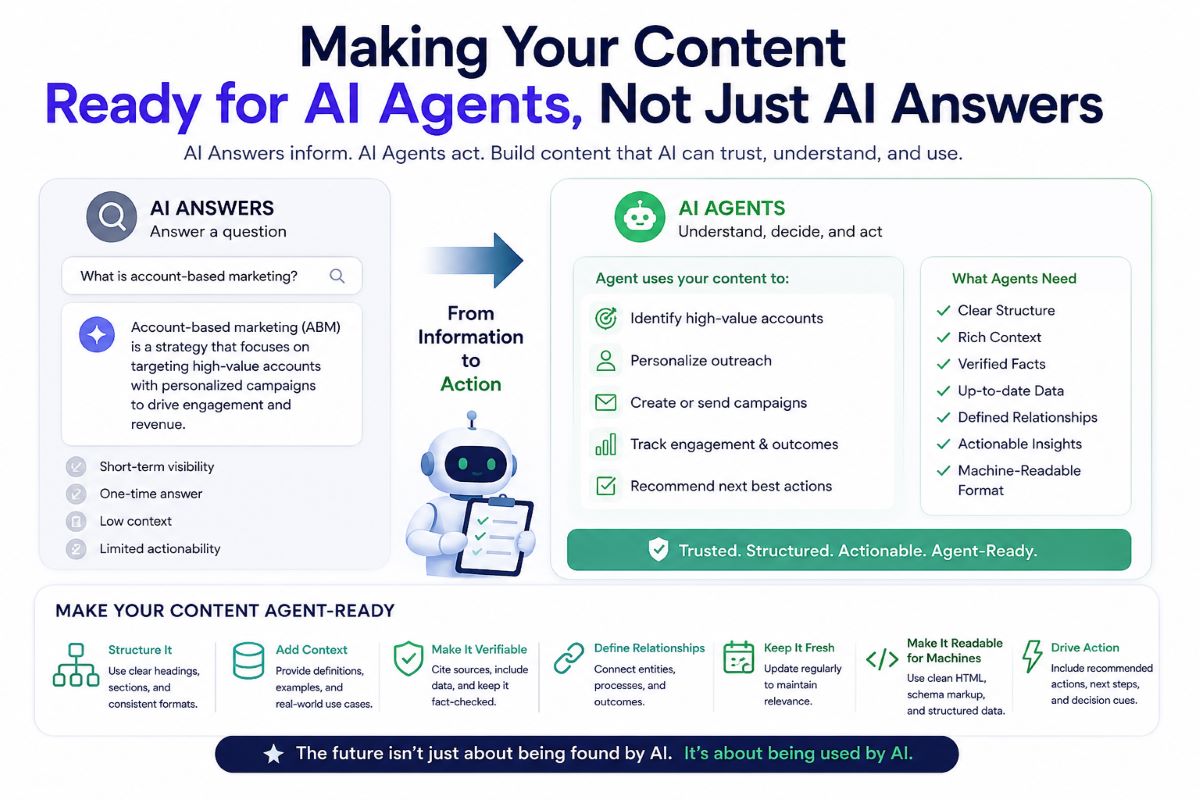
Everything we have discussed so far in this series – content depth, topical authority, earned citations, technical crawlability – has been about being found and quoted. Being a good source of information for a system that is answering a question. AI agents introduce a different challenge: being a viable option for a system that is completing a task. The bar is not “can this be cited” but “can this be used, compared, and acted upon.”
This article is about understanding that shift, what it actually requires from a practical standpoint, and how to think about it without getting swept up in speculation about a future that has not arrived yet.
What Is Actually Different About an AI Agent, Compared to an AI Chatbot
It is worth being precise about the distinction here, because the terms get used loosely and the differences matter for what you need to do.
A conversational AI tool– the kind we have spent most of this series discussing – receives a question, retrieves and synthesizes information, and produces a response. The interaction ends there. A human reads the response and decides what to do next.
An AI agent is built to carry out multi-step tasks toward a goal, with limited ongoing human input. It might research options, compare them against specific criteria, narrow down to a shortlist, check additional details, and in some cases take an action – making a booking, submitting a form, completing a purchase – based on its own evaluation of which option best satisfies the goal it was given.
The practical consequence is that an agent is not reading your content the way a human would, and it is not just extracting a quotable summary the way a retrieval-augmented chatbot might. It is trying to evaluate your offering against specific criteria and decide whether to select it, recommend it, or transact with it. That is a fundamentally different bar to clear.
The Friction Points That Block Agents Even When They Would Not Block a Human
A human visiting your site has a lot of tools for working around small obstacles. They can solve a captcha. They can scroll past a confusing layout to find the information they need. They can infer pricing from a slightly ambiguous page. They have patience, context, and the ability to backtrack and try again.
Agents, at least currently, are far less tolerant of this kind of friction. Some of the most commonly cited blockers include captcha walls that stop automated access entirely, pricing or availability information that only renders through JavaScript interactions an agent does not perform, inconsistent or missing structured data for product attributes, and account or login requirements placed in front of basic information that should be publicly accessible.
None of these things are new problems, exactly. Many of them are the same JavaScript-rendering and crawlability issues we covered in the previous article. But the stakes are different. A retrieval system that cannot fully parse your page might still pull a partial citation. An agent that cannot get past a captcha to check your pricing simply moves on to a competitor that it can access. There is no partial credit.
Structured Data Becomes Even More Important – Particularly for Anything Transactional schema markup as a genuinely useful but not magical technical investment for general content. For anything involving products, pricing, availability, or bookable services, the calculus shifts. This is the kind of information an agent specifically needs to extract cleanly in order to compare your offering against alternatives and make a decision.
Product schema that clearly specifies price, currency, availability, and rating gives an agent exactly what it needs to evaluate whether your product matches the criteria it has been given. The absence of this structured data does not necessarily mean an agent cannot figure out your price – but it means the agent has to work harder to extract that information reliably, and in a comparison context, the option that is easiest to evaluate accurately has a real advantage over the option that requires more inference.
This extends beyond e-commerce. Service businesses with bookable appointments, availability windows, and pricing tiers face the same dynamic. If an agent is trying to find and book a service that meets specific criteria, the businesses whose availability and pricing are represented in clear, structured, machine-readable form are the ones that can actually be evaluated and selected. The ones whose availability only exists as a phone number and a “call for pricing” page are, from an agent’s perspective, functionally invisible – even if a human would have no trouble calling and asking.
The Emergence of Agent-Facing Protocols and APIs
One of the more significant developments in this space has been the emergence of standardized protocols designed specifically to let AI systems interact with external tools and data sources in a structured way. The most widely discussed of these is the Model Context Protocol, an open standard that allows AI systems to connect to external tools, databases, and services through a consistent interface, rather than each AI provider and each business building bespoke, incompatible integrations with each other.
For businesses, the relevance of this is that it represents a more formal, more reliable channel than “hope the agent can parse our webpage” for making your offerings available to agentic systems. Exposing relevant business data -inventory, pricing, availability, service details – through a well-documented interface designed for this kind of consumption is a more deliberate and more durable way of being agent-accessible than relying on a general-purpose webpage to do double duty.
I want to be careful here not to overstate where things currently stand. This is a genuinely emerging area, the standards and adoption patterns are still taking shape, and for most businesses this is not yet an urgent build-it-this-quarter priority in the way that, say, fixing a broken robots.txt file is. But it is worth understanding as a direction of travel. The businesses that will be best positioned as agentic commerce becomes more mainstream are likely to be the ones that started thinking about their data as something other systems need to consume programmatically, not just something humans need to read on a webpage.
If your business has any kind of developer resources or technical roadmap discussions, this is a topic worth having on the radar – not necessarily as an immediate project, but as something to understand and watch, the way mobile-friendly design was worth understanding well before it became existential.
What This Means for Your Content Strategy Specifically
Given that this is still an emerging area, I want to focus on what is genuinely actionable now versus what is worth monitoring.
Make your factual claims unambiguous
Agents evaluating options against specific criteria benefit enormously from content that states facts plainly and specifically. “Starting at $49 per month, billed annually” is something an agent can use directly in a comparison. “Affordable plans designed to fit your budget” is not. This is actually consistent with everything we discussed in Article 3 about specificity and quotability – the same qualities that make content useful for a retrieval system make it useful for an agent trying to evaluate your offering.
Keep your pricing, availability, and specification information current and accessible
If an agent is comparing options based on price or availability and your information is outdated or hard to access, you are either being evaluated on inaccurate information – which can backfire badly if a customer arrives expecting a price that no longer applies – or you are being skipped entirely because the information could not be reliably extracted. Either outcome is bad. Keeping this kind of information accurate, current, and in a consistent, structured format is good practice regardless of agents, but it takes on additional importance here.
Audit your site for the friction points we discussed
Go through the core journeys on your site – the ones that would matter if an agent were trying to evaluate or transact with you – and look for the same things you would look for if you were trying to make the process easier for a person with very little patience. Captchas in front of basic information. Pricing that requires multiple clicks or account creation to reveal. Critical details that only exist in images or PDFs rather than as readable text. Each of these is a point where an agent may simply give up and move to a competitor.
Do not panic-build for a future that has not fully arrived
I want to end this section with a note of caution, because there is a real risk of overcorrecting here. Some of the GEO commentary around agentic optimization has a slightly breathless quality – framing this as the most significant shift since the beginning of search itself, and implying that businesses need to fundamentally rearchitect everything immediately.
My honest read is more measured. The fundamentals that matter for agent-readiness – clean structured data, accessible information, unambiguous factual content, technical accessibility – are largely the same fundamentals that matter for everything else we have discussed in this series, and for good technical SEO generally. If you have been doing the work described in Articles 3 through 6 properly, you are already most of the way toward being agent-ready. The incremental additional work is real but not enormous, and it is mostly about extending good practices to product and transactional data specifically, rather than building something entirely new from scratch.
The Bigger Strategic Point: From Being Cited to Being Chosen
There is a useful way to think about the progression we have covered across this series. The earliest stage of GEO is about being included – getting your content retrieved and referenced when someone asks a relevant question. The next stage is about being trusted – building the kind of authority and third-party credibility that makes an AI system confident in representing you accurately. The stage we are discussing in this article is about being selected – being one of the options an autonomous system actually considers and chooses when completing a task on someone’s behalf.
Each of these stages builds on the ones before it. You cannot be selected by an agent if you are not even being retrieved. You cannot be trusted if your information is inconsistent or your factual claims are vague. The work is cumulative, not separate.
What this means practically is that the agent-readiness conversation is not really a fork in the road that requires a different strategy. It is the next layer on top of a foundation you should already be building – and if that foundation is solid, the additional work to be ready for agentic interactions specifically is far more incremental than the more dramatic framing in some corners of the industry might suggest.
Contributed by GuestPosts.biz