


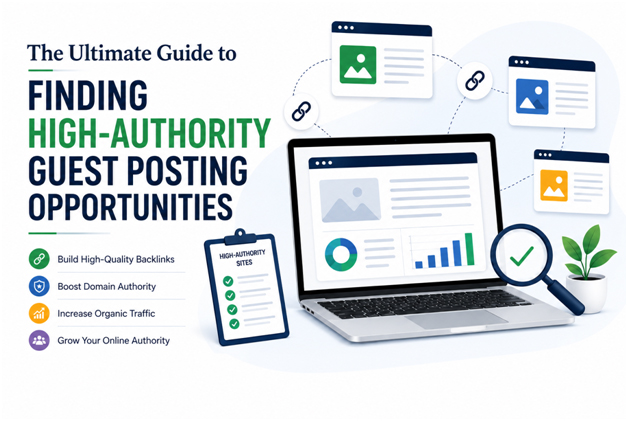
The Ultimate Guide To Finding High-Authority Guest Posting Opportunities
Why this matters in 2026
With AI-generated content flooding most niches, search engines and AI answer tools are doubling down on trust signals. A backlink from a publication with genuine editorial standards and a real readership carries far more weight than it did even two years ago. At the same time, link farms and so-called ‘guest post networks’ are getting penalised more aggressively. Knowing how to identify the right sites -and filter out the wrong ones – is now a core blogging skill, not an advanced one.
When I first started looking for guest posting opportunities, I did what most people do. I typed “write for us [my niche]” into Google, opened the first fifteen results, and worked through the list. Some of those sites looked reasonable on the surface. A few had decent design. Most had domain authority scores that seemed acceptable.
What I did not check – and should have – was whether any of those sites had real readers. Whether real editors made decisions there. Whether the content on those pages was actually being read, shared, and cited by anyone. Several of them were not. They were essentially link repositories dressed up to look like blogs. Getting published there felt like an achievement until I realised the backlinks were doing almost nothing.
Finding high-authority guest posting opportunities is not complicated. But it requires a different approach from most of what gets recommended online. Here is what actually works.
Stop Searching for ‘Write for Us’ Pages
The “write for us” search is the first thing everyone tries and the last thing that produces consistently good results. Think about what those pages represent. A site that has publicly advertised for guest contributors has, by definition, announced itself as a destination for anyone trying to build links. Every SEO in the world with a content strategy has already found it. The editorial inbox is likely saturated. The published content is often low-quality because the site accepts submissions from anyone.
My honest opinion: the “write for us” approach is fine for getting your first one or two pitches accepted while you are building a portfolio. It is not a long-term authority strategy. The sites worth contributing to – the ones with genuine editorial standards and real audiences – usually do not advertise for guest writers. They accept contributions selectively, through direct outreach, from writers whose work they have already noticed.
This means the search process has to be more deliberate. You are not browsing a job board. You are identifying publications your ideal reader trusts and figuring out whether those publications accept outside contributions – even if they do not say so publicly.
Start With the Sites Your Competitors Are Already Using
This is the most underused prospecting method I know, and it takes about twenty minutes once you get the hang of it. Find two or three bloggers in your niche who are a step or two ahead of you in terms of authority and visibility. Then look at where they have been published as guest contributors.
You can do this through a backlink analysis tool – Ahrefs, Semrush, and Moz all offer some version of this functionality, including limited free tiers. Search for the blogger’s website and look at the referring domains pointing to it. Sites that have linked to their content through a byline or author page are almost certainly publications where they contributed. Make a list of those sites. That list is your prospecting shortlist, curated by someone who has already done the vetting work for you.
I used this method when I was trying to break into the content marketing space. I found three writers whose work I respected, ran their sites through a basic backlink check, and identified eleven publications they had contributed to. Eight of those sites were ones I had never come across through regular browsing. Three of them became some of my most valuable placements.
Use Google Search Like a Journalist, Not a Marketer
When you do use search engines to find opportunities, the query matters enormously. Instead of “write for us,” try searching for the types of content you want to write alongside terms that indicate a publication accepts contributors. “Guest post by” followed by your niche. “Contributing editor” followed by a topic. “This post was written by” combined with a subject area your audience cares about. These searches surface actual published guest posts, which means they surface publications that have already run external contributions.
You can also go topic-first. Search for the article you want to write -the specific question or angle you have in mind – and see which publications come up in the top results for that subject. Those are the sites with enough authority to rank for competitive terms in your niche. They are also, almost by definition, the sites where a published piece would carry the most SEO weight. Whether they accept guest contributions is a separate question you can answer with one visit and sometimes one email.
How to Actually Tell if a Site Is Worth Your Time
This is where most advice goes wrong. People default to domain authority as the primary filter. Domain authority matters, but it is a lagging indicator that can be gamed. I have seen sites with DA 50+ that had almost no real readership, no social presence, and content so thin it clearly existed to host links rather than inform anyone. A backlink from a site like that is worth very little.
Check the comments and social shares.
A publication with real readers has articles that get commented on, shared, and linked to organically. If every article on a site has zero comments and no visible social engagement, the audience does not exist in any meaningful sense. You are publishing into a vacuum.
Look at the editorial standards.
Read three or four published articles properly. Are they well-researched? Do they cover topics with any real depth? Does the site have visible editorial policies, an about page with real people named on it, and content that is clearly being updated regularly? These signals tell you whether a human with standards is making publishing decisions.
Check the traffic trend, not just the number.
Similarweb and Semrush both offer traffic estimates. A site with 20,000 monthly visitors and a growing trend is considerably more valuable than one with 80,000 monthly visitors that has been declining for eighteen months. Growth signals relevance. Decline often signals that the site is losing editorial investment.
Check when the last guest post was published.
A site that accepted outside contributors in 2022 but has not published one since may have quietly closed that door. Pitching a dead programme wastes everyone’s time. Look for recent contributor bylines before you write a word of your pitch.
Communities and Newsletters Are Overlooked Gold Mines
Some of the best guest posting opportunities I have come across were not found through search engines at all. They came through communities-niche forums, Slack groups, LinkedIn communities, subreddits, and industry newsletters where editors and bloggers are openly discussing content needs and calling for contributors.
Editors who run newsletters are particularly approachable. A newsletter with a loyal readership of ten thousand engaged subscribers can deliver better referral traffic than a blog with fifty thousand monthly visitors, simply because the audience is more concentrated and more trusting. Many newsletter operators actively look for guest contributors and have no formal system for finding them. An email that arrives at the right moment with a specific, relevant idea can get a yes faster than six months of pitching traditional publications.
Podcast shows are another angle most guest bloggers overlook entirely. Many podcasters with established audiences also run companion blogs or show notes sections that accept written contributions. The host already has a vetted audience. The content standards are high because their reputation depends on it. And the competition for placement is almost nonexistent compared to traditional blogging platforms.
Build a Prospect List, Not a To-Do List
Once you start finding good opportunities, resist the urge to pitch them all immediately. Build a prospect list first. A simple spreadsheet with columns for the site name, the editor’s name if you can find it, the traffic estimate, a note on editorial standards, the date of the most recent guest post, and a column for your proposed article idea. That list becomes your research asset.
Prioritise the list by relevance first, authority second. A moderately authoritative site that is squarely in your niche and clearly accepts external contributions is a better target than a high-authority general site where your topic will sit awkwardly alongside unrelated content. Contextual relevance of a backlink matters as much as the raw authority of the site it comes from – and this is a point that a lot of standard SEO advice glosses over.
Aim to pitch three to five sites per month, well-researched, with specific ideas tailored to each one. That pace is sustainable, produces a steady stream of placements over time, and builds the kind of editorial relationships that eventually mean editors start reaching out to you rather than the other way around.
The Best Opportunities Are Not Listed Anywhere
Here is the thing about high-authority guest posting opportunities that most articles on this topic do not say plainly enough: the best ones are not sitting in a directory waiting to be found. They exist inside relationships, inside communities, inside the backlink profiles of people who have already done the work of getting published in the right places.
That sounds more mysterious than it is. In practice it means this: spend time in the spaces where editors and bloggers in your niche actually gather. Read the publications that matter in your field, not just the ones that advertise for writers. Pay attention to who is publishing what, and where. Follow the contributors whose work you respect and notice where they are showing up.
Over time, a map of your niche starts to form in your head. You know which publications are worth targeting. You know which editors are approachable. You know which sites have genuine audiences and which ones are just collecting backlink placements. That knowledge does not come from a Google search. It comes from paying attention consistently, over months, to the ecosystem you are trying to become part of.
Start building that map now. Begin with competitor backlinks, sharpen your search queries, get into the communities where your niche lives, and build a proper prospect list. Do not rush to pitch everything at once. The bloggers who approach this methodically – identifying fewer, better targets and researching them properly before reaching out – consistently outperform the ones chasing volume. That pattern holds up every time.
Contributed by Guestposts.biz